The time comes when writer stops thinking that he or she will never manage to sort out the mess that is the first draft of the current work in progress, and begins to see a point in time, in the not too distant future, when it will be finished.
It's an exciting time, because one can look forward to having a new book published, and to starting another one.
The only difficulty is deciding what to write. One of the advantages of being self-published is that one can choose for oneself, without having to worry about whether a particular genre or subject is currently considered marketable.
On the other hand, it can be a disadvantage, because one has to decide for oneself, without the benefit of discussion with an agent or editor who knows about trends in book buying, and about what else is due to be published in the next year or so.
A self-published writer cannot - or should not - wait to see how the current work in progress will sell before deciding what to write next; in digital self publishing, the emphasis should be on getting the next book out as quickly as is consistent with quality, so that readers don't forget one's name.
So, should I write another book about this set of characters, or that set of characters? What about another standalone, similar to the already published one that's been doing quite well? Or that new genre and pen-name I've been thinking about?
Or I could start work on one of my shiny new ideas.
Of course, there is always a shiny new idea to distract the writer away from the work in progress. I have a lot of respect for writers such as Dorothy Dunnett and J. K. Rowling, who conceived multi-volume sagas with ongoing storylines and saw them through to the end - in J. K. Rowling's case, while also dealing with the demands of a new marriage and new babies, overseeing the production of the films, and worldwide fame.
Realistically, I know that the shiny new ideas (currently three of them) need a lot of thought and planning before I can begin writing. While I know the characters and settings, I have no idea of plots!
Of course, if one listened to the doom-mongers who claim that the e-book boom is over, and the Kindle is dead, one wouldn't bother to write anything at all. But the ideas would still be there, so why not write them down and put them out there?
Showing posts with label writing: general. Show all posts
Showing posts with label writing: general. Show all posts
Friday, 30 October 2015

Saturday, 3 October 2015
'The sunlight sparkled on the sea'
Clichés are often clichés for a reason. Sometimes they really do describe what is happening in the most concise and expressive way. The sunlight is sparkling on the sea.

However accurate it might be, the writer who included this phrase in a piece of descriptive writing might be accused of being lazy or unimaginative. But how else would one describe it? 'Ribbons of silver light were reflected off the water'? 'The sunlight created an ever changing pattern of silver light on the waves'? Verging on the pretentious, one feels.
It is a challenge for a writer, to set the scene and create atmosphere, while avoiding the extremes of cliché or purple prose, or, God forbid, becoming a candidate for the Bulwer-Lytton Awards.
These days, a digital camera is almost as essential to a writer as a laptop. Digital cameras are small enough and light enough to be carried everywhere and can be used to record anything that catches the attention. Whether it's a scene like the one above, derelict buildings, a document in a record office, a street scene,

an interesting building,

or an overgrown graveyard,

a writer can build up his or her own reference library of images.
Describing sound is another challenge. Is it possible to improve on Matthew Arnold's description of waves breaking on a shingle beach?

Saturday, 27 June 2015
When one is a crime and mystery writer -
- when one visits a garden,
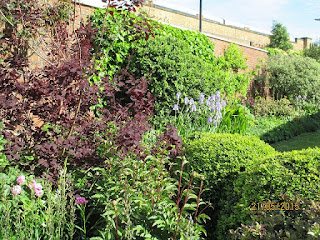
no matter how well laid out,

how well tended,

how well planted,

how colourful,

one is always on the lookout for

a place to hide the body!


no matter how well laid out,

how well tended,

how well planted,

how colourful,

one is always on the lookout for

a place to hide the body!

Tuesday, 9 June 2015
Memories -
I've been having a clear out of some childhood memorabilia and came across my album of Brooke Bond Picture Cards of British Costume. The cards came in packets of tea and one could send away for an album to stick them in.

As an adult, I can see that this was a well-produced collection. Many of the images were taken from well known paintings and the text on the back of each card and in the album was written by Madeleine Ginsburg, a leading fashion historian.

Back then, the priority was to complete the collection. There was always an elusive card or two that never turned up in the packets at our local Co-op or Liptons. I remember having multiple copies of the Victorian lady in blue. but never getting two of the medieval cards. I finally acquired them from a family friend.
I also came across some of my very early writing. Some I remembered, some I had forgotten. It was interesting to read through and see how my style was developing in my early teens. I was already using a lot of dialogue. Originality was not a strong point, however; most of it was heavily influenced by whatever I happened to be reading at the time.
Now I don't know what to do with it. I certainly don't intend ever to show it to anyone else, but can't quite bring myself to rip it up and throw it out for recycling. It will probably go back in the cupboard and continue to take up space for a while longer.
One does not have this problem with computer files!
Monday, 4 May 2015
'His head literally exploded.'
According to the current Writing Magazine, the latest edition of Fowler's Dictionary of Modern English Usage says it's now acceptable to use 'literally' in a metaphorical sense. So what word does one use when one wants to say that something literally did happen?
No-one is going to think that someone's head literally did explode (unless, I suppose, it's a battlefield scene). But what if someone was literally dancing with rage? Or was literally as white as a sheet? Was he or wasn't he?
I'm currently editing the novel I hope to publish soon, a crime/mystery set in Victorian London. One piece of advice to writers that I've found useful, and am trying to put into practice, is to be sure to extract every last piece of drama and tension from a scene. This obviously doesn't apply if two characters are discussing the case over a cup of tea. But if the heroine is in peril, then give her even more reason to be afraid, make the consequences of failure even more catastrophic. Without, one hopes, tipping over into purple prose and Gothic horror!
I'm also checking that all the small details of the plot hang together. When cutting, or changing the order of scenes and events, it's easy for something to fall through the cracks, so a crucial piece of information wasn't shared when it should have been, or one character tells another about something she has not yet done.
Then it will be one final read through for typos, missing punctuation marks, and so on, before uploading.
Then on to the next one.
Wednesday, 4 February 2015
When is a story not a story?
Short story writing is a specific skill quite separate from novel writing. It is a skill that I do not have, so I've asked my friend Helen Spring to share her thoughts on what makes an effective short story. Helen is a novelist and a short story writer. Her work, including her latest publication, a collection of short stories, is available on Amazon. See what Helen has to say below, and if you agree or disagree with her thoughts, please leave a comment.

WHEN IS A STORY NOT A STORY?
ANSWER: When it is almost any other kind of writing. There must have been more differing opinions written about short stories and their structure than almost any other kind of writing. I have my own opinion about short stories, and when I have voiced it, have received comments which ranged from ‘Utter rubbish!’ to ‘You are so right!’
I think we all have an idea of what a story is, and we always know if we have enjoyed it after reading it. So you may feel I am making a difficulty where there is none. But I can enjoy a piece of writing without agreeing that it is a short story. It may simply be a piece of very good writing describing something which happened – in that case I would call it an anecdote. If it was writing which described something in great detail I might call it an essay. So what does a piece of writing have to have which makes it (in my view) a story?
I believe a story worthy of the name has to have a structure which works through the writing so that the reader has a certain reaction at the end, and knows it is a story. Not necessarily ‘a beginning, a middle and an end,’ although that is a good structure, but something has to change during the narrative to make it into a story.
For example: ‘It was very cold, so I decided to buy some warm cloth and make myself a coat. It took me seven years to make but I eventually had a warm coat.’ – That is an anecdote.
But: ‘It was very cold, so I decided to buy some warm cloth and make myself a coat. It took me seven years to make but by then I had put on so much weight I couldn’t wear it.’ – That is a story.
P. D. James probably put it best when she argued: ‘A short story does not have to have a plot, but it does have to have a point.’ So many short stories these days (and many of them are published) seem to me to be just an interesting (or not) piece of writing with very little structure.
Please don’t think I am advocating some sort of moral message, although earlier short stories often did have them, for example children’s stories (Cinderella, The Three Bears, or Aesop’s fables.) All these have survived so long because they made a point which the reader understood. These days you wouldn’t get far trying to moralise in a story, but the description of actions or thoughts and their consequences (often unforeseen) can make for an interesting and satisfying structure.
If one studies acknowledged masters of the short story, (I am thinking of Guy de Maupassant or the American writer O. Henry, for example) one finds there is always that pivotal point (and sometimes you have to search for it) which turns the process and makes a piece of writing become a story.
I’ll quote as an example the story of Cinderella, simply because it is one we all know. What is the pivotal point in that story which has ensured it lasts forever? If you think about it, it is the loss of Cinderella’s glass slipper as she runs from the ball as the clock chimes midnight. Think about it. If she hadn’t lost the slipper, she would have gone home, all her finery would have disappeared and it would be an anecdote. (‘I went to the ball after all and had a good night out.’) By losing the slipper, the Prince is given the opportunity to find the wearer, which makes possible the ‘happy ever after’.
Often when writing a story, I have found it didn’t quite work, and almost always it is because I have not found that pivotal point which will make the story move, to bring about the satisfying (or horrifying or whatever) ending. This pivotal point does not have to be in any particular place in the story, and it does not have to be an action or event, it can simply be a change in thought processes, but I do believe it has to be there.
Well I’m sure some people disagree with me, and if you do I’d love to hear why you think I’m wrong. When do you think a piece of writing deserves the title ‘STORY’ ?
Helen Spring
Thursday, 1 January 2015
New year, new writing
A time for a writer to take stock of achievements to date and plan the next stage of his or her writing career. For me, as well as being a new year, in a few days it will also be the anniversary of publication of my first Kindle novel. I now have three published. It's so far been a very positive, even (in a modest way) profitable, experience.
Independent e-publishing is a great time saver for an author. No need to research potential agents and publishers, put together submissions, wait for them to come back, then start the whole process again. Then, even if a deal is forthcoming, wait again for the book to be published.
For e-publishers, the big unknown going into the New Year is how sales will be affected by the new EU VAT regulations. The VATman will be taking a bigger share of the retail prices of e-books. (Print books are exempt from VAT.) Independent authors, who set their own prices, have the choice of leaving them the same, and making less money per book sold, or increasing them, and possibly losing sales.
I didn't make as much progress with my next novel during the autumn as I'd hoped. I had a muscle injury which took a long time to clear up which prevented me from sitting comfortably at the computer for any length of time. It made me appreciate how incapacitating quite minor injuries could have been in the past, when so many people did manual work and small every day tasks required much more physical effort than they do to today. Making a hot drink could require pumping water and carrying coals, instead of turning on a tap and flicking the switch on the electric kettle.
The next novel I plan to publish is a crime story set in Victorian London. After that I hope there will be another story featuring the main characters from The Plantagenet Mystery.
At the back of my mind I have an idea for a historical mystery with a different setting and central character. I'm a long way from being ready to write it, but from time to time I think about it and make a few notes. The character is in his thirties and happily married. In a historical setting, this would mean there would be children. I don't want the parents to ignore their children (and they are not of high enough status for the children to be spending all their time with nursemaids, governesses and tutors). But neither do I want the children to take over the story!

On an entirely unrelated subject, in the last couple of days I've tried to explore two different online archive catalogues. Neither has a browse function, only a search. I don't want to search for a specific item, I want to browse to look for anything that might be useful or interesting to me. One of these catalogues doesn't even have a brief outline of the structure and content of the archive. How is one supposed to search if one doesn't know what there is to search for?
Independent e-publishing is a great time saver for an author. No need to research potential agents and publishers, put together submissions, wait for them to come back, then start the whole process again. Then, even if a deal is forthcoming, wait again for the book to be published.
For e-publishers, the big unknown going into the New Year is how sales will be affected by the new EU VAT regulations. The VATman will be taking a bigger share of the retail prices of e-books. (Print books are exempt from VAT.) Independent authors, who set their own prices, have the choice of leaving them the same, and making less money per book sold, or increasing them, and possibly losing sales.
I didn't make as much progress with my next novel during the autumn as I'd hoped. I had a muscle injury which took a long time to clear up which prevented me from sitting comfortably at the computer for any length of time. It made me appreciate how incapacitating quite minor injuries could have been in the past, when so many people did manual work and small every day tasks required much more physical effort than they do to today. Making a hot drink could require pumping water and carrying coals, instead of turning on a tap and flicking the switch on the electric kettle.
The next novel I plan to publish is a crime story set in Victorian London. After that I hope there will be another story featuring the main characters from The Plantagenet Mystery.
At the back of my mind I have an idea for a historical mystery with a different setting and central character. I'm a long way from being ready to write it, but from time to time I think about it and make a few notes. The character is in his thirties and happily married. In a historical setting, this would mean there would be children. I don't want the parents to ignore their children (and they are not of high enough status for the children to be spending all their time with nursemaids, governesses and tutors). But neither do I want the children to take over the story!
On an entirely unrelated subject, in the last couple of days I've tried to explore two different online archive catalogues. Neither has a browse function, only a search. I don't want to search for a specific item, I want to browse to look for anything that might be useful or interesting to me. One of these catalogues doesn't even have a brief outline of the structure and content of the archive. How is one supposed to search if one doesn't know what there is to search for?
Monday, 1 September 2014
Getting started
Advice for beginning writers often includes finding a photograph, maybe in a magazine, and writing a description of the person in it. The disadvantage of this is that one can end up with a list of facts but with very little insight into personality - what makes the person tick.
Of course different approaches work for different people and everyone needs to try a variety of methods to find what works best for him or her. What follows is based on what I do at the very earliest stages of planning a novel.
Do not sit down and stare at a computer screen or blank page of a notebook.
Think of a character. Not too much detail at this stage.
Male or female?
Name? This can be changed later if it turns out not to suit him or her. For the purpose of this blog post only, let's say it's a woman called Mary.
Approximate age?
Occupation?
Setting? If it's historical, the approximate year, and whether it takes place in London, in a big town or in the country. At some point you will need to narrow it down to time of year and specific part of the country. But there's no need to do this now.
Put Mary in a situation that requires her to take some action or make a decision. This could be a fairly minor, every day situation such as being delayed on a journey, or a big life changing event.
Go for a walk, do the ironing, weed the garden. Don't consciously try to think about Mary, but if she floats to the surface of your mind, give some thought to her and the situation you've placed her in. How will she react when she discovers it? What will she do about it?
This is actually a very important part of the process. An author might be at this stage for years before putting anything down on paper or on computer. But for the purposes of this exercise, give it from a few hours to a few days.
Now sit down and write about the moment when Mary discovers the situation, showing how she reacts and what she decides to do. You might only write a paragraph, you might write several pages. It doesn't matter; whichever you do, in the end you'll have leaned something about yourself as a writer.
At some point, Mary will need to talk to someone about what has happened. Who will she talk to? Parent? Sibling? Husband? Boyfriend? Child? Friend? Employer? Someone else? How does that person react? Is he or she sympathetic or hostile? How does Mary react to that?
After some more walking/ironing/gardening, sit down and write the conversation between Mary and the other person.
Looking back over the two scenes you've written, as well as showing what the characters are doing and saying, have you shown what they're thinking and feeling? If writing a full length novel, this is something that might come at the editing stage, after the first draft was completed.
The way in which Mary dealt with the original situation, and the conversation she had about it, should have revealed something about her personality and her personal circumstances. What do you know about her now that you didn't know when you started?
You could continue to develop these ideas. What happens as a consequence of the decision or action Mary took at the beginning? What are the repercussions of the conversation she had?
Alternatively, start again with a new character and a new situation.
The aim is to experiment and to find out what comes easily - plot development or character development, narrative or dialogue - and what type of character and setting you like to write about.
Above all, the idea is to relax and let the ideas come to you!
Sunday, 17 August 2014
The Plantagenet Mystery available on Kindle
My new novel is now available on Kindle. The Plantagenet Mystery is set in the present day, but the mystery begins in the fifteenth century and touches the lives of many people through generations.

Historian Rob Tyler finds himself involved in a mystery which has its origins in the times of the clash of dynasties, of battles, treachery and treason, when having the wrong bloodline could be enough to send a man or woman to the executioner's block. As Rob uses his skills as a historian to uncover the secret he finds his courage and determination tested and discovers that the the difference between right and wrong is not as clearcut as he had thought.
See more at my Amazon page.
Wednesday, 11 June 2014
How to write dialogue
Or how I write it, anyway. All writers have to find methods that work for them, by experiment and practice.
If I have two or more characters in a scene, I generally like to have them talking to each other, unless there are good reasons why they should not be. If they are hiding from their enemies, for example, and need to be quiet.
Or perhaps nothing important to the plot is happening at that point and including the whole conversation only slows down the action. If the characters are discussing where to go for a meal, it's probably enough to say 'They decided to go to the Italian restaurant in the High Street' and pick up the dialogue again when there is some important plot or character development.
I have included dialogue in a novel that might have appeared to be unnecessary, but it was a mystery and there was a clue hidden in the characters' apparently aimless chatter!
Scenes involving more than one character which include big revelations about plot or character should always (in my opinion) be written in the form of dialogue.
I'm not a great planner, but if it's an important scene I usually sketch an outline first, to see how I'm going to get the characters to the point they need to be at the end of it. My outline might look something like this:
Jane - Uncle Matthew was worried about something.
Robert dismissive
Jane has read Aunt Maria's diary, so she knows it's true (shows Robert the diary).
Robert - Maria was a batty old lady - or words to that effect.
Jane - How dare you talk about her like that! Storms off.
This scene moves things along in several ways. Robert now knows that Jane has the diary. The reader is left in doubt as to whether Aunt Maria is a reliable witness and Jane's concerns are justified. Jane and Robert have parted on bad terms and Jane might be less inclined to confide in him in future.
Once I'm satisfied that the outline takes the scene in the direction I want it to go, I'll write it out in full, establishing the setting, including any of the characters' thoughts or actions that are important, and writing each character's speech in a way that suits his or her personality. If Jane is a confident person, she'll make definitive statements. If she's more hesitant, she might phrase her remarks in the form of questions or say 'I think' and 'perhaps'.
A character who has had little education is likely to have poor grammar and a limited vocabulary. A pompous character might use a lot of long words and speak in convoluted sentences.
The setting will also influence the way characters speak and act. Jane and Robert's conversation will be different depending on whether they are in Aunt Maria's drawing room, on a country walk, in a noisy, crowded pub or at a formal dinner.
What is most important is that all characters should have their own distinctive voices or ways of speaking. Even if Jane Austen did not tell us who was speaking, the reader would never mistake Mrs Bennet's speech for that of Elizabeth or Lady Catherine de Bourgh.
Friday, 30 May 2014
Why write dialogue?
There are few hard and fast rules in fiction writing, but one is that popular or commercial fiction should have a substantial amount of dialogue. This was not always the case; some nineteenth century authors, such as Sir Walter Scott or Anthony Trollope, wrote page after page, even entire chapters, with no dialogue at all. It's unlikely this approach would win them many readers today.
Exactly how much dialogue is up to the author. My characters talk to each other a lot. Other writers possibly use less. But there must be some.
Dialogue serves several purposes.
It advances the plot. Character A tells Character B something, and at the same time informs the reader:
'My dear Mr Bennet, have you heard that Netherfield Hall is let at last?'
By the end of that scene, which is less than two pages long, a major part of the plot (the possibility that one of the Bennet girls will marry Bingley) has been set up and the reader has learned a fair amount about Bingley and the Bennets, entirely through the conversation between Mr and Mrs Bennet.
Another way dialogue can be used to inform the reader is in crime and mystery novels, when the detective and his or her sidekick recap the crime and review the suspects and their possible motives.
All this could be done in narrative, of course, but that would preclude one of the other prime functions of dialogue: to reveal character. By the end of the opening scene of Pride and Prejudice, the reader knows that Mrs Bennet is talkative, that she likes to gossip, and she is, or likes to think she is, subject to 'nerves'.
Later, in another important plot development, Elizabeth forms her first impressions of Mr Darcy from overhearing his conversation with Bingley:
'She is tolerable, but not handsome enough to tempt me; I am in no humour at present to give consequence to young ladies who are slighted by other men.'
Later, Elizabeth meets the housekeeper at Pemberley:
'He is the best landlord, and the best master,' said she, 'that ever lived; not like the wild young men nowadays, who think of nothing but themselves. There is not one of his tenants or servants but will give him a good name. Some people call him proud; but I am sure I never saw anything of it. To my fancy, it is only because he does not rattle away like other young men.'
Again, this moves the plot along, as it causes Elizabeth to revise her opinion of Darcy.
Dialogue also helps to generate tension:
'Come, Watson, come!' he cried. 'The game is afoot. Not a word! Into your clothes and come!'
is much more dramatic than 'Holmes told me to get dressed quickly and come with him'.
The denouement of a crime novel, when the detective gathers all the suspects in the library in order to reveal the criminal, is another occasion when dialogue is used to create tension.
Dialogue also helps to maintain pace. The opening scene between Mr and Mrs Bennet moves along quickly because it's all dialogue; there is narration only before and after it.
In romance, dialogue can also be used to show that the two people involved are getting to know one another, and that they are well suited. (It is a pet peeve of mine that romance novels too often end with the couple presumed to be heading for a happy ever after when they have barely had a conversation throughout the book!)
And dialogue also serves to entice readers. A prospective reader is not confronted with a wall of text when dipping into a book. He or she can quickly establish, by reading a passage of dialogue, who the characters are and whether he or she wants to read about them.
That is what dialogue is for. How to write it is a subject for another post!
Tuesday, 11 March 2014
Twitter and Daffodils
I've started a Twitter account. I'm not sure what I'm going to do with it, but anyone who wants to can find me there @WriterVictoria. If I've set things up properly, my Tweets will appear below the posts here, and links to my posts here will be Tweeted there.
This photo was taken in York a few years ago, but following the warm weekend we've just had, daffodils seem to have come into bloom everywhere almost overnight. Hosts of golden daffodils indeed.

This photo was taken in York a few years ago, but following the warm weekend we've just had, daffodils seem to have come into bloom everywhere almost overnight. Hosts of golden daffodils indeed.
Wednesday, 25 July 2012
Horse Power
It’s not possible to write contemporary fiction without, sooner or later, mentioning motor cars.
It’s not possible to write historical fiction without, sooner or later, mentioning horses.
For a writer who, like me, doesn’t know much about cars or about horses, this can present difficulties.
These can be circumvented to some extent by having a central character who doesn’t know much about them either. But at some point over the course of a writing career, a central character will be in a position where he or she has to deal with a car or a horse, depending on the setting. Or there will be a secondary character whose job, or personality, requires that he or she knows about one or the other.
Cars and horses are possessions, and like other possessions they can be revealing of the characters of their owners. A man who owns a flashy, expensive car in a contemporary novel would own a flashy, expensive horse in historical fiction.
Horses were everywhere in the past. In 1695 it was estimated that in England about half a million horses were used as cart and plough horses. There were probably at least as many again employed in private ownership, in the carrying trades, in industry and other uses, making a million horses in all. The human population of England at this time was perhaps a little over five million.
The expanding industries of the eighteenth century used horses in increasing numbers. In 1726 a coal mine at Jesmond used more than seven hundred horse drawn wagons to move coal from the pithead to the quayside on the Tyne.
In 1766 two thousand horses a week were used (or two thousand horse journeys per week were made) carrying lead from the mines at Nenthead to Penrith.
In 1835 one coach operator employed 1800 horses.
The arrival of the railways ended long distance stagecoach travel, but overall probably increased the number of horse drawn vehicles on the roads. There were frequent complaints about the congestion caused in London by the railway companies’ vans transporting goods from the termini to their final destinations.
In 1893 one writer estimated that there were 25,000 horses employed in the carrying trades in London. When omnibus, tram and cab horses, and brewers’ horses, were added, that brought number up to 75,000. There were also horses kept for private carriages and by small tradesmen.
All those horses had to be stabled. One railway company had stabling for five hundred horses and one stables near Paddington. Large numbers of men were employed in caring for horses, large quantities of leather were used in making saddlery and harness.
Horses had to be fed; fodder was shipped along the Thames to London in large quantities. The amount of land that had to be devoted to pasturing, and growing fodder for, horses gave cause for concern when the human population was growing rapidly and needed to be fed.
And horses produced manure, which had to be disposed of. A horse might produce fifteen to thirty-five pounds of manure a day. This was not a problem in the countryside where manure could immediately be put to good use and even had a monetary value. It did create difficulties in the towns.
Overall, I think I would rather write about horses than motor cars. Stables and horse fairs are more attractive locations than garages or car showrooms. The weather or the landscape can be used to greater effect in an account of a journey by horse than in an account of a car journey. And a fictional horse can more easily be given a name and a personality than a fictional car.
Sunday, 6 May 2012
Advice to writers
There is an enormous number of 'how to' books for witers. There is an infinite number of online discussion forums, blogs and writers' websites which give advice to writers. One could spend all one's time reading these and never get any actual writing done.
The only piece of advice that no writer should ignore is to pay attention to grammar, spelling and punctuation. Most of the rest may be used as a basis for experimentation, to help each writer discover what works best for him or her.
Much of the advice given to writers is conflicting. To plan or not to plan; to approach an agent first, or a publisher. Some seems to be unrealistic. Authors who self publish are told that they will need to spend two full days a week on promoting their work forever, not just at publication.
Self published authors, whether in print or on Kindle, do need to work hard to get their work noticed, as Roz Southey has recently blogged. But anyone who can spend two full days a week on promotion and still find time to write must have no day job, no family responsibilities, no house or garden to look after, no shopping, cooking, washing or ironing to do, no other hobbies or interests to pursue and no friendships to nurture.
One piece of advice often given to writers is to ignore the phone, not look at e-mail and refuse invitations. Friends will still be there when the writing is done, it's said.
Obviously if a writer has a deadline approaching, then the social life needs to be put on hold. And any aspiring writer who is out pubbing and clubbing every night and so has no time to write should perhaps re-examine his or her priorities.
But writers can become isolated, especially those who do not have other jobs that take them out of their homes. Writing a novel in particular can be a long hard slog. We do need to take a break, get out, talk to other people (in real life, not via e-mail or Facebook or Twitter) and refresh and restock our imaginations.
Human nature is our business, after all, and we can't study it while huddled over our keyboards in our studies. We need to get out, engage in people watching, strike up conversations.
A walk is good. It provides fresh air and exercise and a chance to think about the next scene or chapter. But it perhaps lacks opportunities for interaction with other people.
Buses are good for writers. From the top deck (where there are double deckers) one can see unfamiliar views. (The view from the top deck of a bus was a plot point in at least one crime novel.) If the bus is quiet one can think about one's plot while enjoying the ride.
If the bus is busy, there will be plenty of opportunity to gather material. The conversation going on in the seats behind might provide an idea for a short story. The elderly lady next to you might tell you her fascinating life story, or what your town was like sixty or seventy years ago.
So my advice to writers this week is - go for a bus ride!
Wednesday, 19 October 2011
How not to be a short story writer
I rarely write short fiction. Short story writing, which requires set up, development and resolution in two thousand words or fewer, is a skill that I don't have. The novel, with a plot that takes time to work out, and a large cast of characters, is my natural medium.
However, a while ago I was inspired to write Bess, her story, linked to under 'Pages' above. It's not a story, more a slice of life or character piece. It's not at all my usual style, and I don't think it would work in a longer piece, but it demanded to be written that way.
(The next paragraph discusses the piece, so you might want to read it before reading further here.)

And even in this short (just over two thousand words) piece I have nine named characters, two who are individually described but not named, and others who are mentioned but not individually described.
What is totally lacking, however, is a plot. The characters don't drive the action. They don't make any decisions that change the course of events. They only observe and react.
However, a while ago I was inspired to write Bess, her story, linked to under 'Pages' above. It's not a story, more a slice of life or character piece. It's not at all my usual style, and I don't think it would work in a longer piece, but it demanded to be written that way.
(The next paragraph discusses the piece, so you might want to read it before reading further here.)

What is totally lacking, however, is a plot. The characters don't drive the action. They don't make any decisions that change the course of events. They only observe and react.
Friday, 23 September 2011
E-publishing - or not?
Waterstone's have announced their own e-reader, to go on sale next year. Whether it will be any challenge to the dominance of the Amazon Kindle remains to be seen.
For a writer, the advantages of e-publishing are clear. It's possible to make one's work available directly to readers without going through the time consuming process of repeated submission and rejection, or taking the financial risk of self-publishing in traditional format.
Because there need be no time-lag between completion of a book and its e-publication, it's much easier for a writer to jump into the latest trend in fiction, whether it's vampires or Tudor queens or medieval crime.
Conversely, a writer who e-publishes can experiment with themes and genres currently considered unpopular by traditional publishers and agents.
A traditionally published novel is normally between 75,000 and 120,000 words. Anything shorter or longer isn't commercially viable. An e-book can be any length. Short stories, for which the traditional market is shrinking, are well suited to e-book publication.
When publishing with Kindle, the author sets the price of his or her own book, and keeps a higher percentage than when traditionally published. (E-publishing of course does not have the overheads that have to be covered by traditional publishers.) With paperback prices now not far off £10, an e-book at £2.99 is very attractive. Some of the most successful e-publishing authors have set their prices as low as 99p. And e-books do not go out of print; they remain available unless or until the author or publisher decides to withdraw them.
So what, if any, are the disadvantages to the writer of e-publishing?
E-publishing isn't suitable for any kind of non-fiction where illustrations, maps, charts or tables need to be displayed. The screen of an e-reader is not big enough.
So many e-books are now being published directly by their authors that a book by a new or less well known author is likely to sink without trace. Books that are not published by a known and reputable publisher will not be reviewed in newspapers or magazines. It is much more difficult to browse a list of e-books on a screen than a shelf of books in a shop or library; chance discovery by readers looking for something new is less likely, especially given the sheer quantity of books available.
We hear a lot about the reduction in the amount of editing done by publishers. But it is still the case that a traditionally published book will have been read by at least one person other than the writer, and that person will be someone who is knowledgeable about the industry as a whole and the particular genre into which the book fits.
There are many freelance editors out there, of course, and an e-publishing writer could choose to use one. But unless an e-published book was extraordinarily successful it would be a long time before it earned back the cost of a thorough professional edit.
Then there is the sense of validation that comes with the knowledge that someone else, a professional in the industry, considers one's book good enough to publish, and the satisfaction of holding the published book in one's hand, neither of which is possible with direct e-publishing.
Finally, what about posterity? A paper book may survive indefinitely. Any eighteenth century writer of Gothic romance, any early twentieth century writer of girls' books, may one day be rediscovered and republished. Their books are accessible in the copyright libraries to any student wanting to research a thesis on the history of the genre.
What will happen to e-books when the technology has moved on, the Kindles are thrown away, and there is no-one around to ensure that an author's books are available in the latest format?
And how will future researchers write the history of popular literature in the twenty-first century when so much of it will no longer be available to them?
Tuesday, 17 May 2011
Saints, students and spin
Hagiography, or the lives of saints, was a popular literary genre in the Anglo Saxon and mediaeval periods. The life of a saint might be written to educate readers about the facts of his or her life, to present an example of spirituality for people to follow, or to promote the cult of a particular saint to encourage visitors to his or her shrine.
Saints’ lives were normally written in Latin, and only later translated into English. This is an English translation of the life of St Richard of Chichester (1197-1253), who is believed to have studied at Oxford:
‘Such was his love of learning that he cared little or nothing for food or raiment. For, as he was wont to relate, he and two companions who lodged in the same chamber had only their tunics, and one gown between them, and each of them had a miserable pallet. When one, therefore, went out with the gown to hear a lecture,, the others sat in their room, and so they went forth alternately. Bread and a little wine and pottage sufficed for their food. Their poverty never allowed them to eat meat or fish except on a Sunday or some solemn holy day, or else in the presence of companions or friends. Yet he has often told me how he never afterwards, in all his days, led such a pleasant and enjoyable life.’
Take out the first sentence and this could be a description of student life at any time. ‘Such was his love of learning…’ suggests to the reader that there was something exceptional about this particular student, that the poverty of this stage of his life foreshadows his later saintliness.
Newspaper articles use words and phrases in a similar way to set up expectations in the reader about the person they are reading about. We are told that someone is ‘unemployed’ or ‘public school educated’, regardless of whether this information is actually relevant to the story.
Queen Elizabeth I, who knew a thing or two about spin, took the technique one step further, setting up expectations:
I know I have the body of a weak and feeble woman -
Then taking her audience by surprise:
But I have the heart and stomach of a king.
Novelists can use similar techniques to set up, and then confound, readers’ expectations.
Thursday, 7 April 2011
Now that April's here -
Robert Browning was not the only poet to be inspired by the English spring. Some of Alfred Noyes’ best known lines, from his poem The Barrel Organ, are on the same theme:
Go down to Kew in lilac-time, in lilac-time, in lilac-time;
Go down to Kew in lilac-time (it isn't far from London!)
And you shall wander hand in hand with love in summer's wonderland;
Go down to Kew in lilac-time (it isn't far from London!)
The cherry-trees are seas of bloom and soft perfume and sweet perfume,
The cherry-trees are seas of bloom (and oh, so near to London!)
And there they say, when dawn is high and all the world's a blaze of sky
The cuckoo, though he's very shy, will sing a song for London.
 And Geoffrey Chaucer pointed out that spring is a time for journeys:
And bathed every veyne in swich licour,
Of which vertu engendred is the flour;
 Whan Zephirus eek with his swete breeth
Inspired hath in every holt and heeth
The tendre croppes, and the yonge sonne
Hath in the Ram his halfe cours y-ronne,
And smale fowles maken melodye,
That slepen al the night with open ye,
(So priketh hem nature in hir corages:
Than longen folk to goon on pilgrimages.
Spring is a good time to set the opening of a novel if the mood is intended to be upbeat and optimistic. But such is the English weather that at any time of year there might be weather to match any mood a novelist might want to establish. An unseasonably warm, spring-like day in January or February, perhaps, or a grey, cold, wet day in July. Snow stopped play in a cricket match in June once.
Conversely, the weather can contrast with a character’s mood; the protagonist’s family and friends might all be enjoying themselves outside in the sunshine while he or she remains indoors trying to deal with bad news or resolve a serious problem.
The weather has influenced real historical events. Storms delayed and ultimately destroyed the Spanish fleet in 1588. Bad weather in the English Channel caused the launch of Operation Overlord to be delayed in June 1944.
In historical fiction especially the weather can be used to raise tension. The hero can be delayed on his way to rescue the heroine from a dangerous situation; the crucial piece of information can arrive too late to stop a wedding or secure an acquittal in a trial.
There’s nearly always something to say about the weather, too. So if two characters who are strangers to each other need to strike up a conversation on a train or in a stagecoach or at an inn, a remark about the weather makes a good starting point.
Go down to Kew in lilac-time, in lilac-time, in lilac-time;
Go down to Kew in lilac-time (it isn't far from London!)
And you shall wander hand in hand with love in summer's wonderland;
Go down to Kew in lilac-time (it isn't far from London!)
The cherry-trees are seas of bloom and soft perfume and sweet perfume,
The cherry-trees are seas of bloom (and oh, so near to London!)
And there they say, when dawn is high and all the world's a blaze of sky
The cuckoo, though he's very shy, will sing a song for London.
And Geoffrey Chaucer pointed out that spring is a time for journeys: Whan that Aprille with his shoures soote
The droghte of Marche hath perced to the roote, And bathed every veyne in swich licour,
Of which vertu engendred is the flour;

Inspired hath in every holt and heeth
The tendre croppes, and the yonge sonne
Hath in the Ram his halfe cours y-ronne,
And smale fowles maken melodye,
That slepen al the night with open ye,
(So priketh hem nature in hir corages:
Than longen folk to goon on pilgrimages.
Spring is a good time to set the opening of a novel if the mood is intended to be upbeat and optimistic. But such is the English weather that at any time of year there might be weather to match any mood a novelist might want to establish. An unseasonably warm, spring-like day in January or February, perhaps, or a grey, cold, wet day in July. Snow stopped play in a cricket match in June once.
Conversely, the weather can contrast with a character’s mood; the protagonist’s family and friends might all be enjoying themselves outside in the sunshine while he or she remains indoors trying to deal with bad news or resolve a serious problem.
The weather has influenced real historical events. Storms delayed and ultimately destroyed the Spanish fleet in 1588. Bad weather in the English Channel caused the launch of Operation Overlord to be delayed in June 1944.
In historical fiction especially the weather can be used to raise tension. The hero can be delayed on his way to rescue the heroine from a dangerous situation; the crucial piece of information can arrive too late to stop a wedding or secure an acquittal in a trial.
There’s nearly always something to say about the weather, too. So if two characters who are strangers to each other need to strike up a conversation on a train or in a stagecoach or at an inn, a remark about the weather makes a good starting point.
Wednesday, 2 March 2011
No man but a blockhead ever wrote...
... except for money, said Samuel Johnson.

'He that condemns himself to compose on a stated day will often bring to his task attention dissipated, a memory embarrassed, an imagination overwhelmed, a mind distracted with anxieties, a body languishing with disease.

Winston Churchill, among all his other achievements, found time to be a prolific writer. Not being a blockhead, and having expensive tastes, he certainly did it for money.
'Writing a book is an adventure. To begin with, it is a toy and an amusement; then it becomes a mistress, and then it becomes a master, and then a tyrant. The last phase is that just as you are about to be reconciled to your servitude, you kill the monster, and fling him out to the public.'

Agatha Christie, through her alter ego, Mrs Ariadne Oliver, said 'first you've got to think of something, and then, when you've thought of it, you've got to force yourself to sit down and write it.'

'When you get the thing dead right and know it's dead right, there's no excitement like it. It's marvellous. It makes you feel like God on the Seventh Day - for a bit, anyhow.'
And Samuel Johnson reminds the writer who is staring despondently at the blank page or computer screen 'what is written without effort is in general read without pleasure.'

Wednesday, 26 January 2011
What's in a name?
Yes, an over-used quotation. And is it even true to say 'that which we call a rose, by any other name would smell as sweet’? Would Romeo and Juliet’s story have the same impact if they’d been called Ron and Mabel? Would Margaret Mitchell’s heroine be so memorable if she’d kept her original name, Pansy O’Hara? Would Archie Leach and Maurice Micklewhite have been so successful if they hadn’t changed their names?
I’m thinking about this because I’m trying to decide on a surname for a character. This character’s surname is only mentioned once, not long after he’s introduced, just so the reader knows what it is. The setting is contemporary, and he’s never in a situation when his surname would be used. But he’s a major character; he ought to have a full name.
I don’t know why I’m struggling with this. I only want an ordinary name of one or two syllables that goes with his first name and isn’t too similar to any of the other characters’ names.
Sometimes I have trouble finding a name because I’m not yet ‘seeing’ the character clearly, but that’s not the case this time.
Sometimes, as I’m writing, I find that the name I originally chose doesn’t fit the character as he or she develops, and I have to change it.
The name has to fit the character. But a child’s name is chosen by its parents, so the name must reflect their personalities too. Amaryllis Jacinta Marigold might be the perfect name for a spirited red haired heroine. But if her parents are supposed to be very staid, unimaginative people, wouldn’t Ann or Jane be more likely?
And as for some of the unsuitable names given to characters in historical fiction - that’s a whole other post!
Subscribe to:
Posts (Atom)