7 February this year was the two hundredth anniversary of the birth of Charles Dickens. He is regarded by many as the greatest English novelist. He was certainly one of the most widely read. The Old Curiosity Shop, first published in serial form, had a circulation of 100,000 in 1840-41. A Tale of Two Cities, first published as a serial in the weekly All the Year Round, had an initial circulation of over 120,000 in 1859. Each copy sold was almost certainly read by more than one person, either in a family home or in the reading room of a Mechanics' Institute or other organisation.
Dickens' success as a novelist is the more remarkable given the variety of other roles or professions he undertook - journalist, pamphleteer, editor, dramatist, producer, actor, public speaker.
Dickens could not have achieved all he did if he had lived at an earlier period. The railways and the postal service enabled the rapid distribution of his serials, and the railways also made it possible for Dickens himself to travel the country giving readings from his novels.
Levels of literacy were rising, even though there was not yet a national, compulsory system of education in England and Wales - that came in 1870, the year of Dickens' death. One estimate suggests that about 1860, about seventy per cent of the population could read - although not necessarily well enough to read one of Dickens' novels.
In the middle decades of the nineteenth century there was a huge increase in reading material of all kinds aimed at the middle and working classes - cheap fiction, weekly illustrated papers, local newspapers.
For those who could not read for themselves, there was the Penny Reading. Dickens himself gave immensely popular public readings of his novels at which the admission fee was a penny. At the other end of the scale, the local schoolmaster or curate might give a reading in a hall or schoolroom. Some penny entertainments were held in theatres and had varied programmes including music. Books were published with chapters specifically intended for use at Penny Readings; shipwrecks and rescues were popular subjects.
If Dickens were to be transported to the present day, he would no doubt soon learn to use the internet and social media to his advantage. He would be much in demand as a commentator on social issues. And with his ability to create memorable characters and to write quickly and to a deadline, he would no doubt have yet another successful career, as a writer of television drama and soap operas.
Thursday, 15 March 2012

Saturday, 25 February 2012
Things I missed
Other things have got in the way of keeping up this blog over the winter. There are several things I might have posted about. Now I have time to get back to blogging, I'll catch up on some of them.
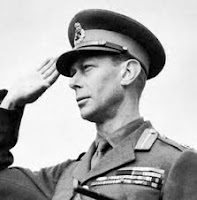
 The King had served in the Royal Navy in the First World War. He very much wanted to be present, on board HMS Belfast, at the D-Day landings in June 1944. However, he was persuaded not to go by his advisers, who said that it would be too great a responsibility for Belfast’s commander to have him on board, and too great a blow to morale if he should be killed. The King then had the task of convincing Winston Churchill, who had also planned to be on board HMS Belfast, that he too should not take the risk.
The King was able to visit the Normandy beach head, and General Montgomery’s headquarters, ten days after the landings.

6 February was the sixtieth anniversary of the accession of the Queen. Normally the royal family does not celebrate this date, because it is also the anniversary of the death of the Queen’s father, King George VI.

George VI was a shy, unassuming family man who had no wish to be king. Following the abdication of Edward VIII, however, he took up the duty and performed it admirably, leading the nation, the Empire and the Commonwealth through the Second World War.
’Personally, I feel happier now that we have no allies to be polite to,’ he wrote after the fall of France in 1940. He and the Queen and the Princesses Elizabeth and Margaret stayed at Windsor throughout the war. The King and Queen travelled daily to London or other areas that had been bombed. When it was suggested that the Princesses should be sent to Canada for safety, the Queen is said to have replied ‘Our daughters could not go without me. I cannot leave the King. And the King will never leave.’

The King was able to visit the Normandy beach head, and General Montgomery’s headquarters, ten days after the landings.

The stress of kingship during such a critical period is said to have contributed to the deterioration of the King’s health from the late 1940s. He died in 1952 aged 56.
Sunday, 19 February 2012
'Mentioned in Domesday'

Celtic, Latin, Anglo Saxon, Danish or Norwegian and Norman French have all contributed to the making of English place names. Thames, Derwent and Avon are all of Celtic origin. Chester, caster and cester all derive from the Latin castra, meaning a military camp.

Ham, ton, ley, stead, wich and wold are a few of the elements used by the Anglo Saxons in naming their settlements. They had many words to describe hills, woods, valleys and farmland.

In the regions settled by Vikings - the East Midlands and the north of England - many place names are of Scandinavian origin. There - and nowhere else - are the bys, the thorpes and the thwaites. A gate is a street, not an entry way, in areas where Danes settled. Old Norse words for features in the landscape such as beck, fell and gill are found in the north west.

All place names have meanings, even if some of those meanings have been lost over time. They can tell us who the original settlers were, about the landscape or what the land was used for. A writer creating a fictional town or village as a setting for a novel might want to check the origin and meaning of the name he or she invents for it. That way the writer can avoid making the mistake the BBC made. While they are quite right to use Wyvern as the name of a fictional county in the south west of England, they are hopelessly wrong in using Holby as the name of a fictional city there.
Subscribe to:
Posts (Atom)